
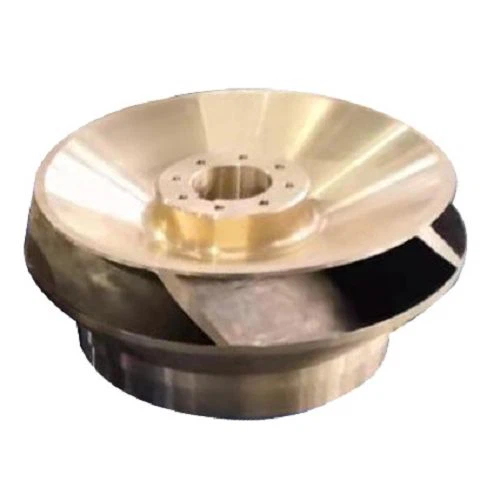
As a supplier of bronze pump impellers, I often encounter inquiries regarding the coefficient of friction of these essential components. Understanding this characteristic is crucial for both engineers and end - users, as it directly impacts the performance and efficiency of the pump. In this blog post, I will delve into the concept of the coefficient of friction of a bronze pump impeller, exploring its significance, factors that influence it, and how it relates to the overall operation of the pump.

What is the Coefficient of Friction?
The coefficient of friction is a dimensionless number that represents the ratio of the frictional force between two surfaces in contact to the normal force pressing the surfaces together. In the context of a bronze pump impeller, these surfaces could be the impeller and the fluid it is pumping, or the impeller and the housing or other mechanical parts within the pump.
Mathematically, the coefficient of friction (μ) is defined as μ = Ff / Fn, where Ff is the frictional force and Fn is the normal force. A low coefficient of friction implies less resistance to motion, which is generally desirable in pump impellers as it can lead to lower energy consumption and reduced wear and tear.
Significance of the Coefficient of Friction in Bronze Pump Impellers
The coefficient of friction plays a vital role in the performance of a bronze pump impeller. When the impeller rotates, it must transfer energy to the fluid to increase its pressure and velocity. A lower coefficient of friction between the impeller and the fluid means that less energy is wasted in overcoming frictional resistance. This results in a more efficient pump operation, translating into lower electricity bills and reduced environmental impact.
Moreover, the coefficient of friction also affects the lifespan of the impeller. High frictional forces can cause excessive wear on the impeller surface, leading to premature failure. By minimizing the coefficient of friction, we can extend the service life of the impeller, reducing maintenance costs and downtime for the pump system.
Factors Influencing the Coefficient of Friction of a Bronze Pump Impeller
- Surface Finish: The smoothness of the impeller surface has a significant impact on the coefficient of friction. A highly polished surface will have a lower coefficient of friction compared to a rough surface. During the manufacturing process, we use advanced machining and finishing techniques to ensure that our Bronze Pump Impeller have a smooth surface finish, which helps to reduce frictional losses.
- Material Properties: The composition of the bronze alloy used in the impeller can also affect the coefficient of friction. Different bronze alloys have varying hardness, ductility, and lubricity, which can influence how the impeller interacts with the fluid and other surfaces. We carefully select high - quality bronze alloys that offer a good balance of strength, corrosion resistance, and low friction properties.
- Fluid Characteristics: The properties of the fluid being pumped, such as viscosity, density, and temperature, can impact the coefficient of friction. For example, a more viscous fluid will generally have a higher frictional resistance against the impeller surface. Our engineers take these fluid characteristics into account when designing the impeller to optimize its performance.
- Operating Conditions: The speed of the impeller, the pressure within the pump, and the presence of contaminants in the fluid can all affect the coefficient of friction. Higher impeller speeds and pressures can increase frictional forces, while contaminants can cause abrasion and increase the coefficient of friction. We provide detailed guidelines to our customers on the proper operating conditions to minimize these effects.
Comparing with Other Pump Impeller Materials
It is also interesting to compare the coefficient of friction of bronze pump impellers with those made from other materials, such as Stainless Steel Pump Impeller and Cast Iron Pump Impeller.
Stainless steel impellers are known for their excellent corrosion resistance. However, in terms of friction, bronze impellers often have an advantage. Bronze has a relatively low coefficient of friction, which can result in better energy efficiency, especially in applications where the fluid has a lower viscosity.
Cast iron impellers are more commonly used in heavy - duty applications due to their high strength. But they tend to have a higher coefficient of friction compared to bronze impellers. This can lead to increased energy consumption and more rapid wear of the impeller surface.
Measuring the Coefficient of Friction
Measuring the coefficient of friction of a bronze pump impeller can be a complex process. Specialized testing equipment is required to accurately measure the frictional forces and normal forces under different operating conditions. At our company, we conduct extensive in - house testing to ensure that our impellers meet the highest standards of performance. We use state - of - the - art tribometers, which can simulate various fluid and operating conditions to measure the coefficient of friction precisely.
Impact on Pump Efficiency
The coefficient of friction directly impacts the efficiency of the pump. A pump with a lower coefficient of friction will have a higher hydraulic efficiency, which is the ratio of the power delivered to the fluid to the power input to the pump. By reducing frictional losses, we can increase the hydraulic efficiency of the pump, resulting in more effective fluid transfer.
For example, in a centrifugal pump, the impeller imparts kinetic energy to the fluid. If the coefficient of friction is high, a significant amount of this energy will be lost as heat due to frictional resistance. By using a bronze pump impeller with a low coefficient of friction, we can maximize the energy transfer to the fluid, improving the overall performance of the pump.
Conclusion and Call to Action
In conclusion, the coefficient of friction of a bronze pump impeller is a critical factor that affects its performance, efficiency, and lifespan. As a leading supplier of bronze pump impellers, we are committed to providing high - quality products with optimized coefficient of friction. Our team of experts uses advanced manufacturing techniques and materials to ensure that our impellers offer the best possible performance in a wide range of applications.
If you are in the market for a reliable and efficient pump impeller, we invite you to contact us for a detailed discussion about your specific requirements. Our experienced sales team will be happy to assist you in selecting the right bronze pump impeller for your application. Whether you need a standard impeller or a custom - designed solution, we have the expertise and resources to meet your needs.
References
- Bowden, F. P., & Tabor, D. (1950). The Friction and Lubrication of Solids. Oxford University Press.
- Holman, J. P. (2002). Heat Transfer. McGraw - Hill.
- Incropera, F. P., & DeWitt, D. P. (2002). Fundamentals of Heat and Mass Transfer. Wiley.